Contributor
RickStudent, Philosopher, Writer, Developer
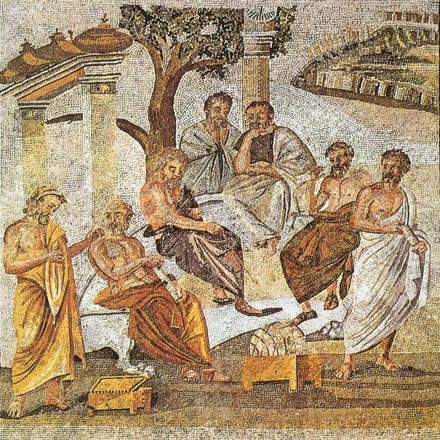
1835 Reconstruction of Plato's Academy, with the Acropolis in the background, from Hellenic Library - Alexander S. Onassis Public Benefit Foundation
Plato's Academy — 1835 Reconstruction of Plato's Academy, with the Acropolis in the background, from Hellenic Library - Alexander S. Onassis Public Benefit Foundation
Photo Credit: POUQUEVILLE, François Charles Hugues Laurent. Grèce, Paris, Firmin Didot, MDCCCXXXV [=1835]
Plato's Academy 1835 Reconstruction of Plato's Academy, with the Acropolis in the background, from Hellenic Library - Alexander S. Onassis Public Benefit Foundation
1880s painting by Gustav Adolph Spangenberg
Aristotle's School — 1880s painting by Gustav Adolph Spangenberg
Photo Credit: Public Domain, https://commons.wikimedia.org/w/index.php?curid=430141
Aristotle's School 1880s painting by Gustav Adolph Spangenberg
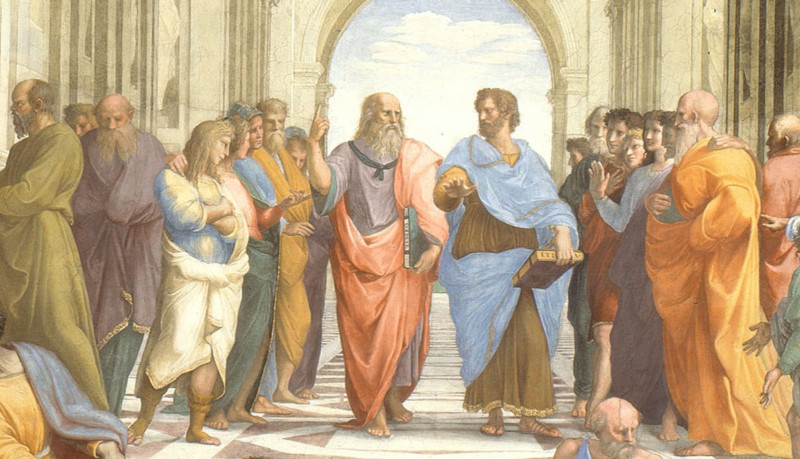
One of the Four Rooms painted by Raphael at the Vatican
The School of Athens — One of the Four Rooms painted by Raphael at the Vatican
Photo Credit: By Raphael - Stitched together from vatican.va, Public Domain, https://commons.wikimedia.org/w/index.php?curid=4406048
The School of Athens One of the Four Rooms painted by Raphael at the Vatican
Lyceum of Aristotle in Athens to open to public
Photo Credit: https://archaeologynewsnetwork.blogspot.com/2013/02/lyceum-of-aristotle-in-athens-to-open.html#hLVxSK0fKCcpoK8F.97
Carrying an inscription of Archimedes, the medal is awarded every four years to 2-4 outstanding mathematicians under the age of 40 years old.
The Fields Medal — Carrying an inscription of Archimedes, the medal is awarded every four years to 2-4 outstanding mathematicians under the age of 40 years old.
Photo Credit: By Stefan Zachow of the International Mathematical Union; Public Domain, https://commons.wikimedia.org/w/index.php?curid=2277414
The Fields Medal Carrying an inscription of Archimedes, the medal is awarded every four years to 2-4 outstanding mathematicians under the age of 40 years old.
by Benjamin West (1805). In 75BC Circero discovered and refurbished Archimedes' Tomb with its sculpture depicting the ratio of a sphere to a cylinder with same diameter and height - Archimedes' favorite proof
Cicero Discovering the Tomb of Archimedes — by Benjamin West (1805). In 75BC Circero discovered and refurbished Archimedes' Tomb with its sculpture depicting the ratio of a sphere to a cylinder with same diameter and height - Archimedes' favorite proof
Photo Credit: Public Domain, https://commons.wikimedia.org/w/index.php?curid=14815659
Cicero Discovering the Tomb of Archimedes by Benjamin West (1805). In 75BC Circero discovered and refurbished Archimedes' Tomb with its sculpture depicting the ratio of a sphere to a cylinder with same diameter and height - Archimedes' favorite proof
Plutarch represented Archimedes as declaring that Any given weight can be moved by a given force.
Archimedes, "Give me a place to stand on, and I will move the Earth." — Plutarch represented Archimedes as declaring that Any given weight can be moved by a given force.
Photo Credit: By Mechanics Magazine - http://en.wikipedia.org/wiki/Image:Archimedes_lever_(Small).jpg, Public Domain, https://commons.wikimedia.org/w/index.php?curid=1921693
Archimedes, "Give me a place to stand on, and I will move the Earth." Plutarch represented Archimedes as declaring that Any given weight can be moved by a given force.
Parallel rays coming into a parabolic mirror are focused at a point F. The vertex is V, and the axis of symmetry passes through V and F. For off-axis reflectors (with just the part of the paraboloid between the points P1 and P3), the receiver is still placed at the focus of the paraboloid, but it does not cast a shadow onto the reflector.
Parabolic Mirror — Parallel rays coming into a parabolic mirror are focused at a point F. The vertex is V, and the axis of symmetry passes through V and F. For off-axis reflectors (with just the part of the paraboloid between the points P1 and P3), the receiver is still placed at the focus of the paraboloid, but it does not cast a shadow onto the reflector.
Photo Credit: Public Domain, https://commons.wikimedia.org/w/index.php?curid=3222214
Parabolic Mirror Parallel rays coming into a parabolic mirror are focused at a point F. The vertex is V, and the axis of symmetry passes through V and F. For off-axis reflectors (with just the part of the paraboloid between the points P1 and P3), the receiver is still placed at the focus of the paraboloid, but it does not cast a shadow onto the reflector.
Archimedes may have used mirrors acting collectively as a parabolic reflector to burn ships attacking Syracuse.
Parabolic Reflector — Archimedes may have used mirrors acting collectively as a parabolic reflector to burn ships attacking Syracuse.
Photo Credit: By Finnrind (original); Pbroks13 (talk) (redraw) - Image:Archimedes Heat Ray conceptual diagram.png, CC BY-SA 3.0, https://commons.wikimedia.org/w/index.php?curid=4233991
Parabolic Reflector Archimedes may have used mirrors acting collectively as a parabolic reflector to burn ships attacking Syracuse.
Artist Giulio Parigi's interpretation of Archimedes' mirror used to burn Roman ships. c. 1599
Archimedes' mirror — Artist Giulio Parigi's interpretation of Archimedes' mirror used to burn Roman ships. c. 1599
Photo Credit: Public Domain, https://commons.wikimedia.org/w/index.php?curid=9007560
Archimedes' mirror Artist Giulio Parigi's interpretation of Archimedes' mirror used to burn Roman ships. c. 1599
In the Archimedes Palimpsest
A page from On Floating Bodies — In the Archimedes Palimpsest
Photo Credit: By Matthew Kon - http://www.lix.polytechnique.fr/Labo/Ilan.Vardi/arch_eabig.jpg?36,70, Public Domain, https://commons.wikimedia.org/w/index.php?curid=30276470
A page from On Floating Bodies In the Archimedes Palimpsest