Contributor
RickStudent, Philosopher, Writer, Developer
Guillaume de Nogaret
Photo Credit: By Anonymous, Public Domain, https://commons.wikimedia.org/w/index.php?curid=74010444
Also known as the Pont d'Avignon, is a famous medieval bridge in the town of Avignon. The original bridge spanning the Rhône between Villeneuve-lès-Avignon and Avignon was built between 1177 and 1185 and destroyed forty years later during the Louis VIII of France siege to Avignon. The bridge was rebuilt with 22 stone arches. It was very costly to maintain as the arches tended to collapse when the Rhône flooded. Eventually in the middle of the 17th century the bridge was abandoned. The four surviving arches on the bank of the Rhône are believed to have been built in around 1345 by Pope Clement VI during the Avignon Papacy. The Chapel of Saint Nicholas sits on the second pier of the bridge. It was constructed in the second half of 12th century but has since been substantially altered. The western terminal, the Tour Philippe-le-Bel, is also preserved. The bridge was the inspiration for the song Sur le pont d'Avignon and is considered a landmark of the city. In 1995, the surviving arches of the bridge, together with the Palais des Papes and Cathédrale Notre-Dame des Doms were classified as a World Heritage Site.
The Pont Saint-Bénézet — Also known as the Pont d'Avignon, is a famous medieval bridge in the town of Avignon. The original bridge spanning the Rhône between Villeneuve-lès-Avignon and Avignon was built between 1177 and 1185 and destroyed forty years later during the Louis VIII of France siege to Avignon. The bridge was rebuilt with 22 stone arches. It was very costly to maintain as the arches tended to collapse when the Rhône flooded. Eventually in the middle of the 17th century the bridge was abandoned. The four surviving arches on the bank of the Rhône are believed to have been built in around 1345 by Pope Clement VI during the Avignon Papacy. The Chapel of Saint Nicholas sits on the second pier of the bridge. It was constructed in the second half of 12th century but has since been substantially altered. The western terminal, the Tour Philippe-le-Bel, is also preserved. The bridge was the inspiration for the song Sur le pont d'Avignon and is considered a landmark of the city. In 1995, the surviving arches of the bridge, together with the Palais des Papes and Cathédrale Notre-Dame des Doms were classified as a World Heritage Site.
Photo Credit: By Hbarrison - Own work, CC BY-SA 4.0, https://commons.wikimedia.org/w/index.php?curid=61890293
The Pont Saint-Bénézet Also known as the Pont d'Avignon, is a famous medieval bridge in the town of Avignon. The original bridge spanning the Rhône between Villeneuve-lès-Avignon and Avignon was built between 1177 and 1185 and destroyed forty years later during the Louis VIII of France siege to Avignon. The bridge was rebuilt with 22 stone arches. It was very costly to maintain as the arches tended to collapse when the Rhône flooded. Eventually in the middle of the 17th century the bridge was abandoned. The four surviving arches on the bank of the Rhône are believed to have been built in around 1345 by Pope Clement VI during the Avignon Papacy. The Chapel of Saint Nicholas sits on the second pier of the bridge. It was constructed in the second half of 12th century but has since been substantially altered. The western terminal, the Tour Philippe-le-Bel, is also preserved. The bridge was the inspiration for the song Sur le pont d'Avignon and is considered a landmark of the city. In 1995, the surviving arches of the bridge, together with the Palais des Papes and Cathédrale Notre-Dame des Doms were classified as a World Heritage Site.
Coat of Arms of the Dominicans
Photo Credit: By Cybhernan - Own work, CC BY-SA 4.0, https://commons.wikimedia.org/w/index.php?curid=39592326
In the Basilica of Saint Paul Outside the Walls, Rome
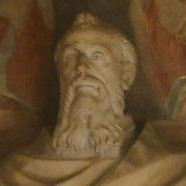
Pope John XXII — In the Basilica of Saint Paul Outside the Walls, Rome
Photo Credit: By Unknown author - Public Domain, https://commons.wikimedia.org/w/index.php?curid=42731881
Pope John XXII In the Basilica of Saint Paul Outside the Walls, Rome

Vytenis as depicted in the Sapieha Genealogy in Kodeń, 1709
Witenes — Vytenis as depicted in the Sapieha Genealogy in Kodeń, 1709
Photo Credit: Public Domain, https://commons.wikimedia.org/w/index.php?curid=12216003
Witenes Vytenis as depicted in the Sapieha Genealogy in Kodeń, 1709
Family of Gediminas
Photo Credit: https://en.wikipedia.org/wiki/Family_of_Gediminas
Liutgard of Saxony
Photo Credit: Public Domain, https://commons.wikimedia.org/w/index.php?curid=8303416
From a genealogy of the Ottonians (Chronica St. Pantaleonis, 2nd half of 12th century. Herzog August Bibliothek, Wolfenbüttel, Cod. Guelf. 74.3 Aug., pag. 226)
Bruno the Great — From a genealogy of the Ottonians (Chronica St. Pantaleonis, 2nd half of 12th century. Herzog August Bibliothek, Wolfenbüttel, Cod. Guelf. 74.3 Aug., pag. 226)
Photo Credit: Public Domain, https://commons.wikimedia.org/w/index.php?curid=8301824
Bruno the Great From a genealogy of the Ottonians (Chronica St. Pantaleonis, 2nd half of 12th century. Herzog August Bibliothek, Wolfenbüttel, Cod. Guelf. 74.3 Aug., pag. 226)
Henry I, Duke of Bavaria
Photo Credit: Public Domain, https://commons.wikimedia.org/w/index.php?curid=8301767
Otto II, Holy Roman Emperor
Photo Credit: By Meister des Registrum Gregorii - Public Domain, https://commons.wikimedia.org/w/index.php?curid=30524851
Cropped from photo by Olaf Kosinsky
Gerhard Schroder — Cropped from photo by Olaf Kosinsky
Photo Credit: By Olaf Kosinsky - Unknown source, CC BY-SA 3.0 de, https://commons.wikimedia.org/w/index.php?curid=67536757
Gerhard Schroder Cropped from photo by Olaf Kosinsky